ATTILA

French Pattern Travertine: Set Sizes and Coverage Explained
Some flooring styles never go out of fashion. French Pattern is one of them.
Inspired by traditional European stone flooring, French Pattern combines four different tile sizes into a beautifully balanced, repeating arrangement. The result is a floor with natural movement, character and a timeless architectural appeal.
From Mediterranean-inspired courtyards to contemporary Melbourne homes, French Pattern works equally well across classic and modern spaces.
At Attila's Natural Stone & Tiles, our French Pattern collection includes beautiful natural stone options such as travertine, dolomite, marble and bluestone, with different colours, textures and finishes to suit your project.
What Is the French Pattern?
French Pattern, also known as Versailles Pattern, is a modular tile arrangement that combines four different sizes to create one continuous design.
Unlike standard square or rectangular tiles laid in straight rows, French Pattern introduces variation through its mixture of smaller and larger pieces.
The beauty is in its balance. The pattern looks organic and effortless, yet each tile is positioned within a carefully designed repeating layout.
It's particularly popular for living areas, courtyards, pool surrounds, patios and indoor-outdoor spaces.
What Sizes Are Used in Attila's French Pattern?
Our traditional French Pattern format uses four different tile sizes, with six pieces forming one complete set.
|
Tile dimensions |
Pieces per set |
|
203 × 203 mm |
2 |
|
203 × 406 mm |
1 |
|
406 × 406 mm |
2 |
|
406 × 610 mm |
1 |
|
Total |
6 pieces |
Together, these six pieces cover approximately 0.742 m² before allowing for grout joints.
The sizes are designed to work together in a repeating modular arrangement, creating the distinctive French Pattern appearance.
Many of our traditional French Pattern natural stone products are available in 12 mm thickness, although dimensions, thicknesses and finishes should always be confirmed for the particular product.

Why You Cannot Buy a Single Size
The pattern only works when all four sizes are present in the correct proportion. Take one out and the repeat cannot close, which is why the set is supplied as a balanced mix rather than as separate products.
That is also why the material is quoted per square metre rather than per piece. It is the reason a shortfall is not normally remedied by ordering extra of one size: adding pieces without the others simply leaves you with stone that has nowhere to go in the layout.
How Do the Four Pieces Fit Together?

The four sizes are proportioned against one another so they lock into a square module, and that module is what repeats across the surface. Once you can see the module, the pattern stops looking random and starts looking like the system it is.
Each piece is sized against the smallest square, which is what lets the set close into a square with no gaps and no cutting through the body of the pattern.
The third panel is the one worth dwelling on. Within the module, every joint stops, steps across and picks up somewhere else. That is not a happy accident of mixing sizes, it is the arrangement doing its job, and it is the reason a French pattern surface reads as stone rather than as tiling.
Two things follow for your project. The pattern cannot be assembled by pulling pieces out of the crates in the order they come, so your tiler needs the layout drawing in hand before the first piece is bedded. And because the module is square, it can be turned and flipped, which is where the layout choices open up.
The arrangement shown here is one common version. The proportions hold across suppliers because the interlock depends on them, but the exact module can differ, so confirm it against the set we are supplying.
How Is French Pattern Laid?
The key to French Pattern is following the correct modular layout.
The four tile sizes are arranged together, with the six-piece set repeated across the floor to create a continuous pattern.
Rather than laying each size independently, your installer should follow the appropriate French Pattern layout diagram and plan the placement before installation.

Planning the layout
1. Confirm the four tile sizes
Check that the complete French Pattern set has been supplied, including the correct quantities of each size.
2. Establish the pattern
Your installer should dry-lay a section to understand the repeating design and check how the natural colour variation flows.
3. Plan the starting position
Consider the room or outdoor area's shape, main sightlines, thresholds and edges to minimise awkward cuts.
4. Maintain consistent joints
Joint widths should suit the specific stone and its dimensional tolerances. Natural stone may require different allowances depending on whether edges are sawn, tumbled or chiseled.
5. Repeat the module
Once the layout is established, continue the pattern across the space while accounting for perimeter cuts and installation requirements.
For the most consistent result, we recommend using an experienced natural stone tiler who understands modular layouts.
Our French Pattern Natural Stone Collection
-
French Pattern is not limited to one type of natural stone. The choice of material, colour and finish can completely transform its appearance.
Travertine French Pattern
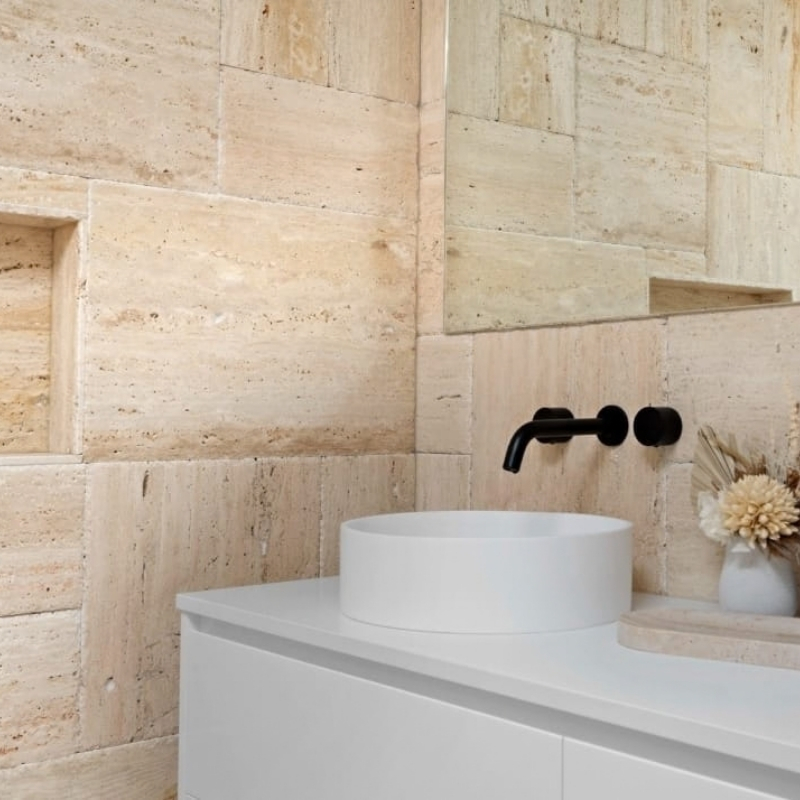
Travertine is one of the most popular materials for French Pattern flooring.
Its soft beige, cream, taupe and silver tones create a warm, natural appearance inspired by Mediterranean architecture.
At Attila's, our French Pattern travertine range includes selections such as Loranda French Pattern, Noche French Pattern and Sahara Silver French Pattern.
Depending on the product, finishes may include brushed, tumbled or chiseled.
Travertine is especially attractive for courtyards, alfresco areas and pool surrounds, where lighter colours can also be a more comfortable choice underfoot during summer.Dolomite French Pattern
For a more refined, contemporary appearance, dolomite offers beautiful natural variation and sophisticated colour movement.
Our Silver Galaxy French Pattern range is an example, with distinctive grey tones that complement both contemporary and traditional spaces.
Different surface finishes may be available depending on the product and intended application.Bluestone French Pattern
Bluestone offers a stronger, more architectural appearance, particularly in grey and charcoal tones.
Its natural character makes it an attractive choice for courtyards, landscaping and contemporary outdoor spaces.
When selecting darker bluestone for exposed outdoor areas, consider how warm the surface may become in direct summer sunlight.Marble French Pattern
For interiors and selected architectural applications, marble French Pattern introduces a more luxurious appearance.
Products such as Magic Black French Pattern can create striking floors with natural variation, movement and depth.
The suitability of each marble should be assessed for its intended environment and finish.
Where Can French Pattern Be Used?
- Living areas: Create natural movement across larger floors without relying on repetitive straight grout lines.
- Courtyards: Introduce a relaxed European character that works beautifully with landscaping and outdoor furniture.
- Pool surrounds: Lighter-coloured travertine and other suitably specified natural stones can offer an elegant finish. Appropriate wet-area slip resistance is essential.
- Outdoor entertaining areas: French Pattern can help create a natural transition between landscaping and architectural spaces.
- Entryways: A beautiful way to introduce natural stone texture and character from the moment you enter a home.
How Much French Pattern Do You Need?
To estimate the required quantity, first calculate the area of your floor in square metres.
For the traditional Attila's six-piece French Pattern set, the tiles cover approximately 0.742 m² per set before grout joints.
Your installer should then calculate the number of complete sets needed and allow for cuts, breakages, layout adjustments and wastage.
As a general planning guide, 10–15% extra material may be appropriate for many projects, although irregular spaces and diagonal layouts can require more.
Always have your installer confirm the final quantities before ordering.
French Pattern: Installation and Maintenance
Like any natural stone, French Pattern requires appropriate installation to perform well over time.
The correct substrate preparation, adhesive, grout, drainage and waterproofing arrangements depend on whether the tiles are installed indoors, outdoors or around a pool.
Many natural stones also benefit from a suitable impregnating sealer to help resist staining and moisture absorption.
The appropriate sealing product and maintenance schedule depend on the particular stone and finish.
For everyday care, use a suitable pH-neutral stone cleaner and avoid harsh acidic cleaning products on acid-sensitive natural stone.
Frequently Asked Questions
How many different tile sizes are in French Pattern?
Attila's traditional French Pattern uses four sizes: 203 × 203 mm, 203 × 406 mm, 406 × 406 mm and 406 × 610 mm.
How many tiles are in one French Pattern set?
One traditional set contains six tiles: two small squares, one small rectangle, two larger squares and one large rectangle.
Is French Pattern suitable for outdoor areas?
Yes, provided the chosen stone, thickness, surface finish and installation system are suitable for the intended outdoor application.
Can French Pattern be installed indoors?
Absolutely. French Pattern is a beautiful option for living areas, kitchens, hallways and other internal flooring applications, subject to selecting an appropriate material and finish.
Is French Pattern difficult to lay?
It requires more careful planning than a conventional straight tile layout. An experienced installer should understand the repeating module, tile proportions and edge cutting requirements.
Do all French Pattern products come in 12 mm thickness?
Not necessarily. While 12 mm is common in our traditional natural stone French Pattern range, thickness and sizing vary by product and should be confirmed before ordering.
Explore French Pattern at Attila's Natural Stone & Tiles
French Pattern is proof that the most beautiful designs don't need to be complicated.
Its combination of carefully proportioned tiles and natural stone textures creates a timeless flooring style that suits everything from Mediterranean-inspired gardens to contemporary Melbourne interiors.
Explore our range of travertine, dolomite, bluestone and marble French Pattern tiles at our Campbellfield showroom.
Our team can help you compare materials, colours, finishes and available stock before you finalise your selection.
Share this Post