ATTILA
Natural Stone vs Porcelain Benchtops: Which Is Right for Your Melbourne Kitchen?
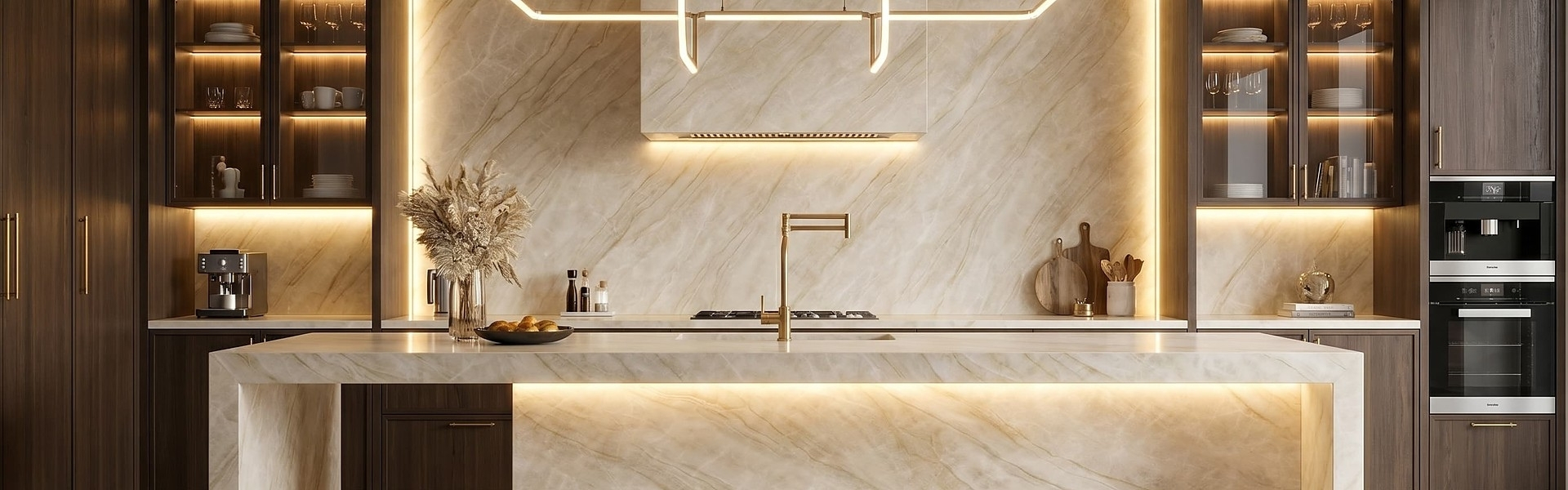
Natural stone gives you a benchtop nobody else has, formed over millions of years, with real depth and movement. Porcelain gives you a non-porous surface that effortlessly shrugs off heat, stains, and scratches. Both are excellent choices. The decision comes down to whether you want authentic character or absolute low-maintenance peace of mind. See both in full slabs at Attila's Natural Stone in Campbellfield, Melbourne.
What natural stone actually is
Natural stone is quarried, cut and polished. Nothing is added. Marble, granite, dolomite, quartzite, travertine, limestone, bluestone and onyx all come out of the ground with their colour and veining already formed.=
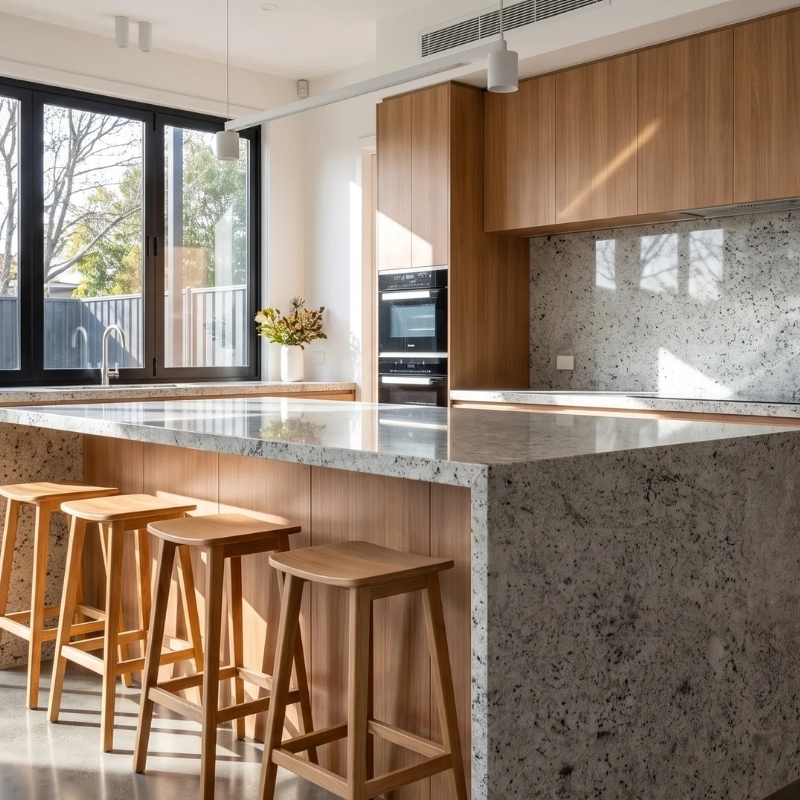
That's the whole appeal. The pattern on your benchtop was made by geology, not by a printer, and no other kitchen in Melbourne has the same one. Veining runs through the thickness of the slab rather than sitting on the face, so an exposed edge or a mitred waterfall shows the same movement as the top.
The trade off is that it's a natural material with natural behaviour. Carbonate stones like marble and dolomite react to acids. Harder stones like granite and quartzite are far less fussy. You choose the stone to match the household.
What porcelain slabs actually are
Porcelain slabs start as clays, feldspar and mineral pigments, pressed under enormous pressure and fired at very high temperature. The result is a dense, glass hard slab with almost no porosity.
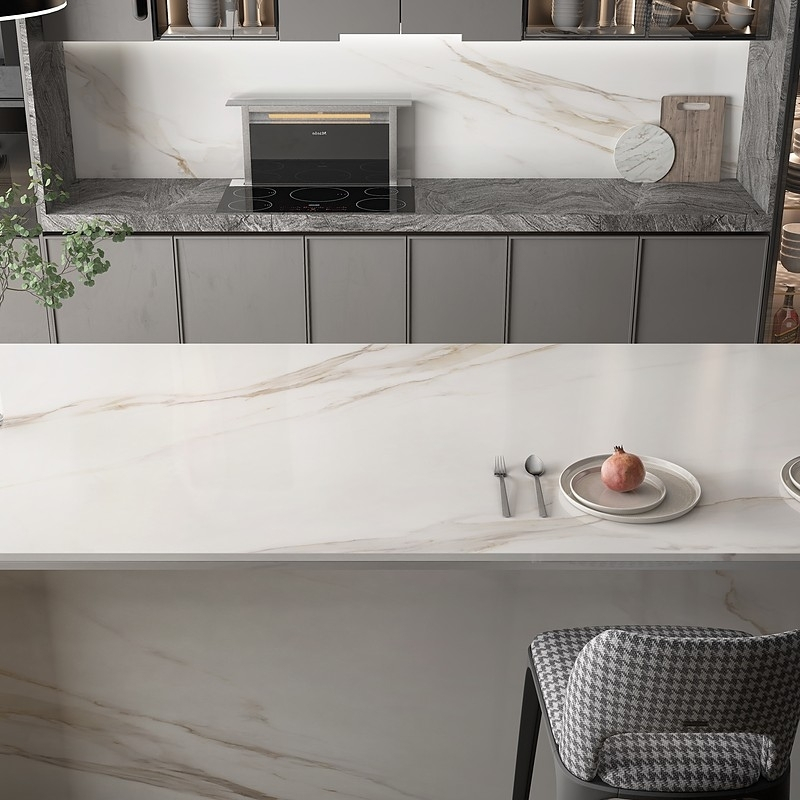
Standard slabs run 3200 x 1600 x 12mm, with jumbo formats at 3600 x 1800 x 12mm. That scale is a large part of the appeal, because a long island or a full height splashback can often be done in a single piece with no join.
The surface is non-porous and naturally stain-resistant. It handles hot pans without scorching and resists scratching well. Finishes run from matt through to polished, and the décor options include marble looks, concrete looks and solid neutrals. Our range of porcelain benchtops covers both standard and jumbo slabs.
Head to head: the differences that matter
- Uniqueness. Natural stone is one of a kind. Porcelain repeats by design, so the slab you see is the slab everyone gets.
- Etching. Marble and dolomite can dull where acid sits. Granite, quartzite and porcelain are far more resistant.
- Heat. Both handle hot cookware well. Neither likes a red hot pan dropped onto an unsupported edge.
- Scratching. Porcelain, granite and quartzite are all very hard. Marble is the softest of the group.
- Edges and joins. Natural stone shows its pattern through the full thickness. Porcelain's décor sits on the face, so mitred edges need careful fabrication to look right.
- Repair. A chipped porcelain edge is harder to make invisible than a chipped natural stone edge, because there's no depth of pattern to blend into.
Which one suits your kitchen?
Choose natural stone if you want your benchtop to become a genuine feature of the room and you value the character, depth and individuality that only a natural material can provide. Every slab is unique, giving you the opportunity to select the exact piece you love and work with the veining, movement and colour to create something completely your own.
Natural stone also brings a sense of quality and permanence that can be difficult to replicate with manufactured surfaces. Marble, quartzite, dolomite and granite have a richness and tactile beauty that can elevate the entire kitchen and, when selected well, can contribute to the perceived quality and value of the home.
It is particularly well suited to renovations where the kitchen is intended to feel timeless rather than trend-driven. If you are comfortable with a little ongoing care, such as wiping spills promptly, natural stone rewards you with a surface that can age beautifully and develop even more character over time.
Choose porcelain if low maintenance, durability and design flexibility are high on your list. Porcelain can replicate looks that natural stone simply can’t, including concrete, timber, terrazzo, metal and other contemporary finishes, while still offering the practicality of a hard-wearing surface.
It’s also a strong option if you want a more consistent colour and pattern across a large open-plan space, or you’re creating a long island, splashback or feature wall and want a clean, continuous look. For busy households, porcelain is particularly appealing because it is highly resistant to stains, heat and everyday wear.
A common compromise is to run porcelain on the hardworking perimeter benches and a natural stone island, so you get the feature piece where people look and the fuss free surface where the cooking happens. The natural stone kitchen benchtops range and the porcelain range are stocked in the same warehouse, which makes comparing them straightforward.
Frequently Asked Questions
Is natural stone or porcelain better for kitchen benchtops?
Neither is universally better - the right choice depends on the look, maintenance and character you want from your kitchen.
Natural stone such as marble, quartzite, granite and dolomite offers genuine variation, depth and individuality. No two slabs are exactly the same, making it an ideal choice when you want the benchtop to become a feature of the room.
Sintered porcelain is generally chosen for its low maintenance, consistency and broad range of designs. It can reproduce stone-inspired patterns as well as concrete, terrazzo, timber, metal and other finishes that aren't naturally available in stone.
What is the difference between natural stone and sintered porcelain?
Natural stone is quarried from the earth and cut into slabs, while sintered porcelain is a manufactured surface made from mineral-based materials that are compacted and fired at very high temperatures.
Because natural stone is formed naturally, every slab has its own veining, colour movement and characteristics. Porcelain is manufactured, allowing greater consistency and a much wider range of colours, patterns and finishes.
Does natural stone increase the value of a home?
Natural stone can contribute to the perceived quality, desirability and premium feel of a kitchen, particularly when a beautiful slab is thoughtfully selected and professionally installed.
Materials such as marble, quartzite and granite are often associated with high-quality residential design and can make a strong impression on prospective buyers.
However, no benchtop material can guarantee a specific increase in property value, as the value of a home depends on many factors.
Compare both under the same light
Photographs can't settle this one, because the difference between a printed vein and a geological one is something you see in person and not on a screen.
Visit the Attila's Natural Stone showroom and warehouse in Campbellfield to see natural stone and porcelain slabs side by side in full sheets, compare finishes, and choose the exact slab for your kitchen at wholesale pricing. No appointment required.
Share this Post