ATTILA

Penetrating vs Topical Stone Sealers: Which and When
A penetrating sealer protects your stone from the inside and leaves its appearance exactly as it was. A topical sealer sits on top of the stone and changes it. That distinction matters, because sealers are sold under half a dozen names, impregnating, penetrating, enhancing, topical, surface and coating, and the labels rarely make the difference obvious. Choosing the wrong type for the wrong surface is one of the few stone mistakes that is genuinely difficult to undo.
At Attila's Natural Stone & Tiles Supplier in Campbellfield, we supply natural stone across Melbourne and advise on protecting it. This guide gives you a clear decision on which type to use, where it belongs, and how often to revisit it.
What Does a Stone Sealer Actually Do?
A sealer does not make stone waterproof or stain-proof. It slows absorption, which buys you time to wipe up a spill before it soaks in and becomes a stain. That single correction changes how you should read every product label you pick up.
Natural stone sits on a spectrum of porosity. Travertine, limestone and marble sit at the absorbent end, with open pore structures that take on liquid readily. Granite and quartzite are far denser and accept much less. Porcelain and terrazzo behave differently again, because they are manufactured surfaces with their own characteristics rather than quarried stone.
That spectrum is why there is no single right sealer and no single right frequency. Two surfaces in the same kitchen can call for different products and different attention. The stone you have chosen drives the decision.
At our Campbellfield showroom and warehouse we stock marble, granite, travertine, limestone, dolomite, bluestone, quartzite, porcelain, terrazzo, onyx and silica-free quartz. Each behaves its own way the moment liquid touches it, and knowing where your slab sits on that spectrum is the first step in protecting it properly.
How Does a Penetrating Sealer Work?
A penetrating sealer carries active ingredients down into the stone's pore structure, where they bond below the surface. The pores end up lined rather than filled, so the stone can still breathe and release moisture vapour. Nothing is left sitting on top.
That mechanism produces four practical consequences:
- The appearance of the stone is essentially unchanged. The slab you selected is the slab you keep looking at.
- There is no film to scratch, scuff, cloud or peel, because there is no film.
- It is the correct choice for outdoor stone, where trapped moisture is the main enemy.
- When it wears, it wears evenly and invisibly rather than in patches, so you never get a dulled band worn through a traffic path.
Penetrating sealers come in two sub-types. A natural-look impregnating sealer leaves the colour of the stone as it is. A colour-enhancing sealer deepens the stone's natural tone and brings out its veining and movement, and it does this without forming a film on the surface.
Be deliberate about the enhancing option. It is an aesthetic decision rather than a protective upgrade, and it is difficult to reverse once a whole surface has been treated. Test it on an offcut of your actual slab first, in the light the stone will live in, and judge it once it is fully dry. If you are weighing it up, we can talk through the natural stone sealer choices for your particular stone.
Where a Penetrating Sealer Is the Right Choice
-
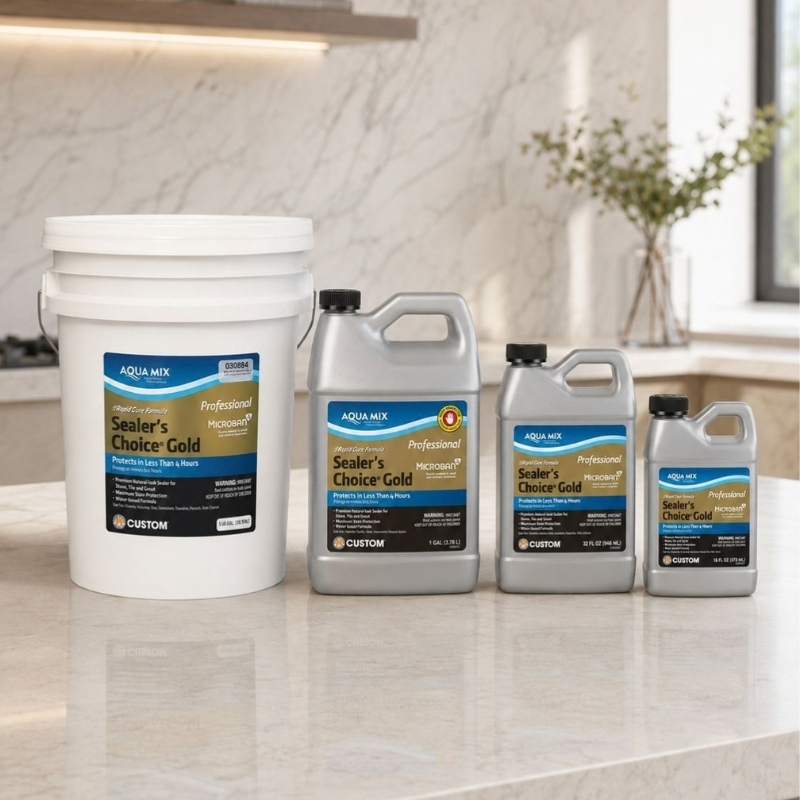
A penetrating sealer is the default for almost every surface in the stocked range: outdoor paving, pool surrounds and coping, bluestone, travertine, limestone, marble and dolomite benchtops, stone floors, splashbacks and stone vanities.
If your project looks like an exception, treat it as something to check rather than something to guess at. Discuss it with us and with the sealer manufacturer before anything is applied, because the manufacturer's data for that specific product is the authority on what it suits.
How Does a Topical Sealer Work?
A topical sealer forms a coating that sits on top of the stone rather than entering it. The protection comes from that layer standing between the surface and whatever lands on it.
It has genuine advantages. It can deliver a high-gloss or satin sheen that a penetrating product cannot produce, and on some interior surfaces it acts as a sacrificial layer that takes the wear instead of the stone.
The trade-offs are real and worth stating plainly:
- It is visible, and it changes the appearance of the stone you chose.
- It scratches, scuffs and wears unevenly wherever there is traffic.
- It can cloud or go milky if moisture becomes trapped beneath it.
- Removing it is not a wipe-off job. The coating has to be stripped.
- On outdoor stone in Melbourne's wet-then-hot cycle, trapped moisture is a common failure mode rather than a theoretical one.
There are places where a topical product earns its spot: certain interior decorative applications, and low-traffic feature surfaces where the finish itself is the point and wear is unlikely. If that describes your surface, confirm suitability with the sealer manufacturer for your specific stone before you commit to it.

Frequently Asked Questions
What is the difference between a penetrating and a topical sealer?
A penetrating sealer absorbs into the stone and protects it from within, leaving the appearance unchanged and allowing the stone to breathe and release moisture vapour. A topical sealer forms a film on the surface that adds sheen, but that film can scratch, cloud, wear unevenly or peel away over time.
Which sealer is best for outdoor stone?
A breathable penetrating sealer. Melbourne's wet-then-hot cycle means moisture gets into outdoor stone and then has to escape as it dries. A film-forming topical sealer can trap that moisture beneath the surface, which leads to clouding, milkiness or peeling, and the only remedy is stripping the coating off.
Does sealing natural stone make it stain-proof?
No. A sealer slows absorption so you have time to wipe a spill away before it penetrates, rather than creating an impermeable barrier. Acidic substances such as lemon juice and vinegar can still etch calcium-based stone including marble, travertine and limestone, whether or not the surface has been sealed.
How do I know when my stone needs resealing?
Use the water-drop test. Place a few drops of water on an inconspicuous area, leave them several minutes, then look at the stone. If the drops bead and the stone appears unchanged, the sealer is working. If the stone darkens, it is absorbing. Spills leaving a shadow is another sign.
Can I use an enhancing sealer to darken my stone?
Yes. A colour-enhancing penetrating sealer deepens the natural tone of the stone and brings out its veining without forming a film on the surface. The effect is difficult to reverse once applied, so always test it on an offcut first. Attila's can supply an offcut for testing.
For the natural stone we supply into Melbourne projects, a breathable penetrating sealer is the default and a topical sealer is a specific aesthetic exception. The porosity of the stone drives that choice, not the room the stone is going into. A marble benchtop and a marble vanity call for the same thinking.
Reading a label will tell you what a product is. It will not tell you whether it suits the slab in front of you, and that is the question you actually need answered. Asking the supplier who knows that stone is quicker than working it out alone.
Not sure which sealer suits your stone? See the natural stone sealer in Melbourne options, or call Attila's Natural Stone & Tiles Supplier on 03 9357 7814. The Campbellfield showroom at 197-201 Barry Rd is open Monday to Saturday, 9:00 AM to 5:00 PM.
Share this Post