ATTILA

Which Natural Stone Handles Melbourne Weather Outdoors?
Melbourne's weather can change dramatically, from intense summer heat to cold, wet winters. Choosing the right outdoor stone is about more than appearance. It's about finding a surface that complements your home while remaining practical throughout the seasons.
Whether you're designing a pool surround, courtyard, driveway or outdoor entertaining area, natural stone offers a beautiful and lasting solution. However, different stones perform differently depending on sun exposure, surface finish, moisture and installation.
At Attila's Natural Stone & Tiles, we help homeowners, landscapers and designers understand these differences so they can select the right stone for their project.
What Should You Consider When Choosing Outdoor Stone?
Before selecting an outdoor stone, consider four important factors.
Heat underfoot: This is particularly important for pool surrounds and areas regularly used barefoot. Some stones can become very hot when exposed to direct summer sunlight.
Slip resistance: Outdoor paving should have an appropriate surface finish and verified slip resistance for its intended application, particularly around pools and wet areas.
Durability: Consider exposure to weather, foot traffic and, where relevant, vehicles or pool chemicals.
Maintenance: Different natural stones have different absorption characteristics and may benefit from suitable sealing and routine care.
Bluestone
Bluestone has long been associated with Melbourne's architectural character. Its distinctive grey and charcoal tones work beautifully in contemporary landscaping, courtyards, pathways and outdoor entertaining areas.
One consideration is heat. Darker bluestone can absorb considerable warmth in direct sunlight and may become uncomfortable under bare feet on hot summer days.
This doesn't make bluestone unsuitable for outdoor use. It simply means its location, colour and exposure should be considered when choosing paving, particularly around pools.
Efflorescence can also occasionally appear on some installations. This is not inevitable or exclusive to bluestone. It depends on factors including the stone, soluble salts, installation materials, moisture exposure, drainage and sealing practices.
We supply bluestone pavers and tiles and cut them to exact measurements for paving, steps and coping.
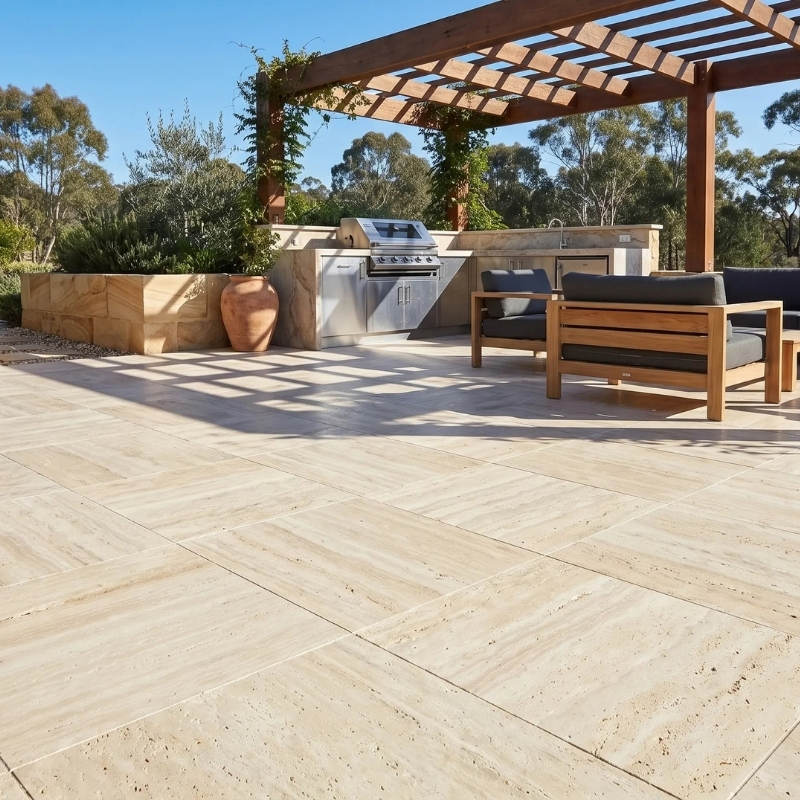
Travertine and Limestone: Pale and Cool Underfoot
These two are the right answer for pool surrounds and barefoot areas, provided you accept the upkeep that comes with a more porous stone.
Both are calcium-based sedimentary stones and they behave similarly outdoors. Both are more porous than bluestone or granite. Both are pale, which is exactly the point: a light surface reflects more heat and stays noticeably cooler underfoot through a Melbourne summer. That single property is why travertine dominates pool surrounds and alfresco areas across the city.
The upkeep is straightforward but not optional. They will etch if an acidic cleaner is used on them, so the cleaning products you choose matter. And they need drainage that does not leave water standing on the surface or sitting in the bedding beneath it.
Finish matters too. Outdoors, use tumbled or brushed travertine, and honed or brushed limestone. A polished finish does not belong underfoot outside: it is slippery wet, it shows wear quickly, and it works against the relaxed character of both stones.
We stock travertine in the full range of outdoor finishes alongside our limestone, and you can compare the two side by side at the Campbellfield showroom, which is the only reliable way to judge the colour difference.
Granite
Granite is an exceptionally hard-wearing natural stone, making it a strong choice for driveways, pathways, high-traffic areas and outdoor landscaping.
Its dense composition provides excellent durability, while textured finishes can be selected for applications requiring additional grip.
However, granite can also become very hot under direct sunlight, particularly darker varieties. For barefoot areas, especially around pools, it is worth comparing granite with lighter-coloured alternatives.
Our recommendation: Bluestone and granite are excellent choices where durability and architectural character are the priority. For exposed pool surrounds, heat underfoot should be considered before finalising your selection.
Porcelain: When a Manufactured Surface Is the Right Answer
Porcelain is a fired ceramic product rather than a natural stone, and in some outdoor situations it is simply the better engineering answer.
Its advantages are real. Absorption is very low, which removes the central failure mode described earlier. Colour and format are consistent from piece to piece, so a large area lays out predictably. Textured outdoor finishes are available. And it needs no sealing at all, which takes an entire maintenance task off the list.
The trade-offs are equally real. There is no natural variation, and some people read that consistency as flat or uniform next to the depth of real stone. It is harder to cut and modify onsite, so changes late in a project are more awkward. And a chipped edge shows the body of the tile beneath the surface, which is more visible than a chip in stone.
Porcelain sits alongside the natural stone range here as a legitimate choice rather than a compromise, and it is often the sensible specification for commercial projects, high-traffic paths and entries where maintenance has to be minimal.
Melbourne Outdoor Stone Compared
|
Stone |
Density and porosity |
Underfoot in summer sun |
Maintenance level |
Best outdoor uses |
|
Bluestone |
Dense, low to moderate porosity |
Dark and warmer |
Low to moderate |
Paving, steps, coping, heritage and inner-Melbourne settings |
|
Travertine |
Moderate density, higher porosity |
Pale and cooler |
Moderate |
Pool surrounds, alfresco areas, barefoot spaces |
|
Limestone |
Moderate density, higher porosity |
Pale and cooler |
Moderate |
Courtyards, sheltered paving, pool areas |
|
Granite |
Very dense, very low porosity |
Varies with colour, darker tones warmer |
Low |
High-traffic paths, entries, driveway aprons |
|
Quartzite |
Very dense, very low porosity |
Varies with colour |
Low |
High-traffic and exposed areas, steps |
|
Porcelain |
Manufactured, very low absorption |
Varies with colour |
Very low |
Commercial projects, high-traffic paths, low-maintenance areas |
For a pool surround in full sun, start with travertine or limestone. The pale colour is doing the work here, and barefoot comfort is the thing you will notice every day of summer.
For a high-traffic path, driveway apron or commercial entry, start with bluestone, granite or porcelain. Density and low maintenance matter more than tonal subtlety on a surface that takes constant use.
If the brief is heritage, or the site sits in inner Melbourne where bluestone is already the vernacular, bluestone is the contextually correct answer and usually the one that satisfies planning as well as the client. You can see the full range of outdoor tiles and compare pavers across all six materials at the showroom.

What Matters as Much as the Stone You Choose
- Falls and drainage. Water has to leave the surface rather than sit in it. This is the single highest-value decision on an outdoor project and it is made before any stone is selected.
- The bedding and adhesive system. It has to be rated for external use and matched to the stone. Your tiler or landscaper specifies this, and it is worth asking them to confirm it in writing.
- Expansion and movement joints. Large areas need them. Thermal movement is real in this climate, and a surface with nowhere to move will find somewhere.
- Slip classification. Obtain the classification for the specific product and finish from us, then check it against the requirements for your project. Any compliance requirement should be confirmed against the relevant Australian Building Codes Board or Victorian Building Authority guidance rather than assumed.
- A realistic cleaning routine. Be honest about what will actually happen. A stone that needs attention you will not give it is the wrong stone for you.
On scope: we supply the stone and cut it to exact measurements in our onsite workshop. Laying, bedding, waterproofing and drainage are carried out by your own tiler, landscaper or builder.
Frequently Asked Questions
-
What is the best natural stone for outdoors in Melbourne?
Bluestone, granite and quartzite lead on durability and low maintenance. Travertine and limestone suit pool surrounds and pale, cool surfaces. Porcelain works where minimal maintenance matters most. The right answer depends on sun exposure, traffic and how much upkeep you will do. Attila's in Campbellfield stocks all of them.
Does natural stone crack in Melbourne frost?
The risk comes from water sitting in or under the stone through a cold snap, not from cold alone. Correct falls, drainage and bedding are what protect an outdoor surface. Discuss your specific stone and its exposure with your supplier before you finalise the specification.
Which outdoor stone stays coolest underfoot?
Pale stones reflect more heat, so ivory and classico travertine and light limestone stay coolest underfoot. Dark bluestone and darker granites run warmer in direct summer sun. For barefoot areas such as pool surrounds and alfresco spaces, choose from the pale end of the range.
Is porcelain better than natural stone outdoors?
Porcelain has very low absorption and needs no sealing, which suits high-traffic and commercial areas. Natural stone offers variation, depth and character that porcelain cannot replicate. Neither is superior in general terms. The better choice depends on the project, its traffic and the look you are after.
Which outdoor stone needs the least maintenance?
Porcelain asks the least of you, followed by the dense natural stones, granite and quartzite. Travertine and limestone are the more porous options and need the most attention. Whatever the stone, correct falls and drainage do more for an outdoor surface than any amount of cleaning afterwards.
In Melbourne the decision comes down to density, colour and maintenance, and every stone in the range wins on at least one of those three. Bluestone brings density and context. Travertine and limestone bring the pale, cool surface that barefoot areas need. Granite and quartzite bring durability with very little asked of you. Porcelain takes maintenance almost to zero. Let the exposure and traffic of the project pick the stone, rather than the photograph that started the idea.
One last thing worth saying plainly: natural stone varies from batch to batch, and no photograph or sample chip tells you what a surface will look like across an entire courtyard. Comparing real slabs and tiles side by side, in daylight, is the only reliable way to choose.
See the full range of outdoor tiles in Melbourne, or compare the stones side by side at the Campbellfield showroom, 197-201 Barry Rd, open Monday to Saturday, 9:00 AM to 5:00 PM. Call Attila's Natural Stone & Tiles Supplier on 03 9357 7814 to discuss your project.
Share this Post